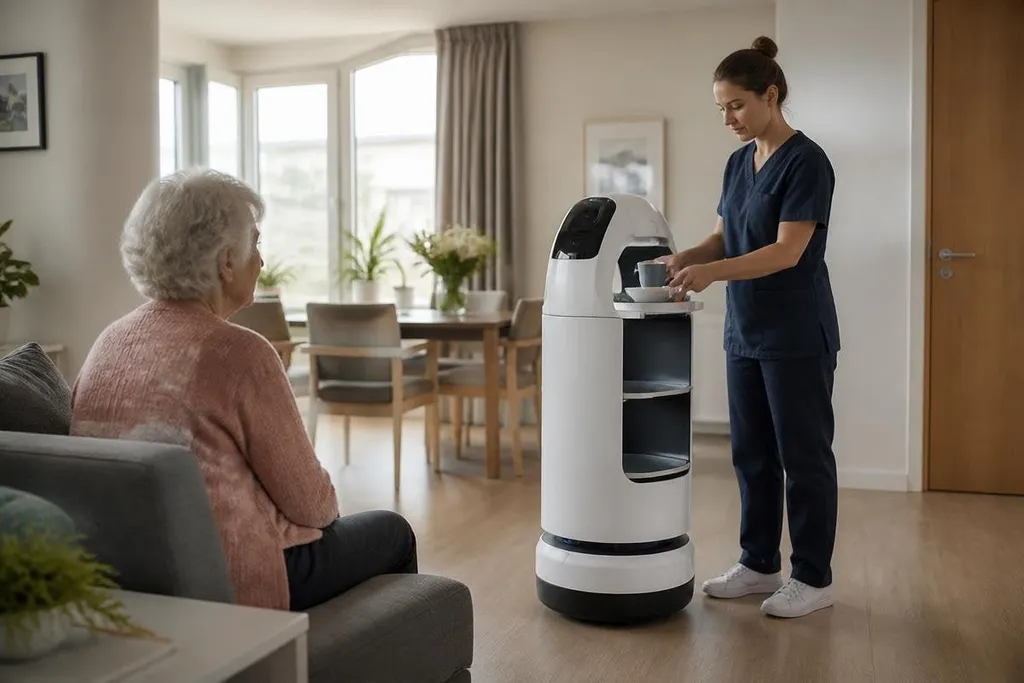
A care robot has to work in a real home, around people, for months after the sale. That makes elder care a service business as much as a hardware business, with revenue tied to setup, maintenance, training, and safe daily use.
- Home support: Robots could help with reminders, calls, simple checks, and movement around the home.
- Care-site work: Facilities could use robots for transport, room checks, and routine supply runs.
- Long-term income: Service plans may matter more than the first hardware sale.
The first opportunity is routine work
Care workers spend time on tasks that need attention but little judgment. For routine work, the robot could carry meals, move laundry, remind someone about an appointment, or connect a resident with a family member. Each task sounds small, yet a product becomes easier to sell when it removes a clear piece of work.
The business case depends on the task staying within the robot’s limits. A company that sells a cart-moving robot can define its route, load, doors, and charging point. A company that promises broad care has to deal with homes and residents it cannot predict.
That difference affects the buyer. A care home can set up marked routes and charging areas.
A home-care provider may face narrow halls, loose rugs, pets, stairs, and several house layouts in one day. The second setting needs more setup work and may create higher service costs.
Care data needs a clear boundary
When reminders or movement checks are part of the job, the robot may handle personal data. That creates work for the seller before the robot enters a home or care site. The company needs clear rules for storage, access, alerts, and family accounts.
If its sensors cannot read the room, it might stop, ask for help, or send an alert. Those choices should be visible to the buyer, because a silent failure can create more work for a carer.
That risk changes how a care provider judges the robot’s business case. Reporting from Robot24 can place the care task, test setting, human handoff, and failure record beside the maker’s sales claim. Those details show whether the robot can support paid services after installation, leading into the costs that follow.
Revenue can come after the sale
A low purchase price may help a provider start a trial, but it won't cover the cost of visits, software updates, replacement parts, or staff training. A monthly service plan could bundle those jobs, provided the buyer can see what they get and what happens when the robot stops working.
Training may become a separate service. Staff need to know how to restart the robot, move it safely, report a fault, and explain its limits to residents. Families may need a different form of training, focused on alerts, privacy, and control of the robot’s features.
A seller can also build income around site surveys. Before delivery, a technician can check door widths, floor surfaces, lift access, charging space, and network coverage. That work reduces failed installations, but it also shows why elder care robots won't behave like ordinary home electronics.
Where the limits sit
The hardest sales pitch is emotional. Families may want a robot that reduces loneliness or replaces a human visit. Calls and prompts can come from a robot, but that does not prove it can meet a person’s social or care needs.
I’d judge an elder care robot by the task it finishes safely, not by how human its voice sounds.
Care providers may also reject a product that adds alerts without reducing work. If staff must check false alarms, charge the robot, move it out of the way, and explain failures, the system has created a new duty. A pilot needs to measure that extra work before a wider rollout.
A buying checklist for care providers
Use these questions before paying for a trial:
- Name the task: Can the supplier state the exact job, route, load, and handoff?
- Check the fallback: What does the robot do when a sensor cannot read the room?
- Price the service: Are setup visits, repairs, updates, training, and parts included?
- Set the data rule: Who can see alerts, recordings, and account details?
- Measure staff time: Does the trial record new duties as well as time saved?
- Ask for proof: Can the supplier show results from a similar home or care site?
The best early customers may be care providers with repeatable spaces and narrow tasks. That gives the seller a clear route to test safety, support costs, and staff acceptance before asking a robot to handle the full mess of elder care.
The business question is plain: can one robot remove enough paid work or risk to cover its hardware, service, and human support costs? Until a supplier answers that with site-level figures, elder care robots remain a pilot purchase rather than a dependable care business.